WhatsApp Message Templates
A WhatsApp message template is a message that Meta has approved in advance. You need one to start a conversation, or to message someone more than 24 hours after their last message: reminders, booking confirmations, broadcasts and automations all send templates. Inside an open 24-hour conversation you can reply freely without one.
When you connect WhatsApp, a set of ready-made templates for reminders and confirmations is submitted for you. You can add your own at any time.
Before you start
- Connect WhatsApp. See WhatsApp Cloud API.
- Staff with access to Engage can manage templates; you do not need to be an admin.
Open your templates
Go to Engage > WA Templates. You can also open the Message Templates tab on the WhatsApp integration page.
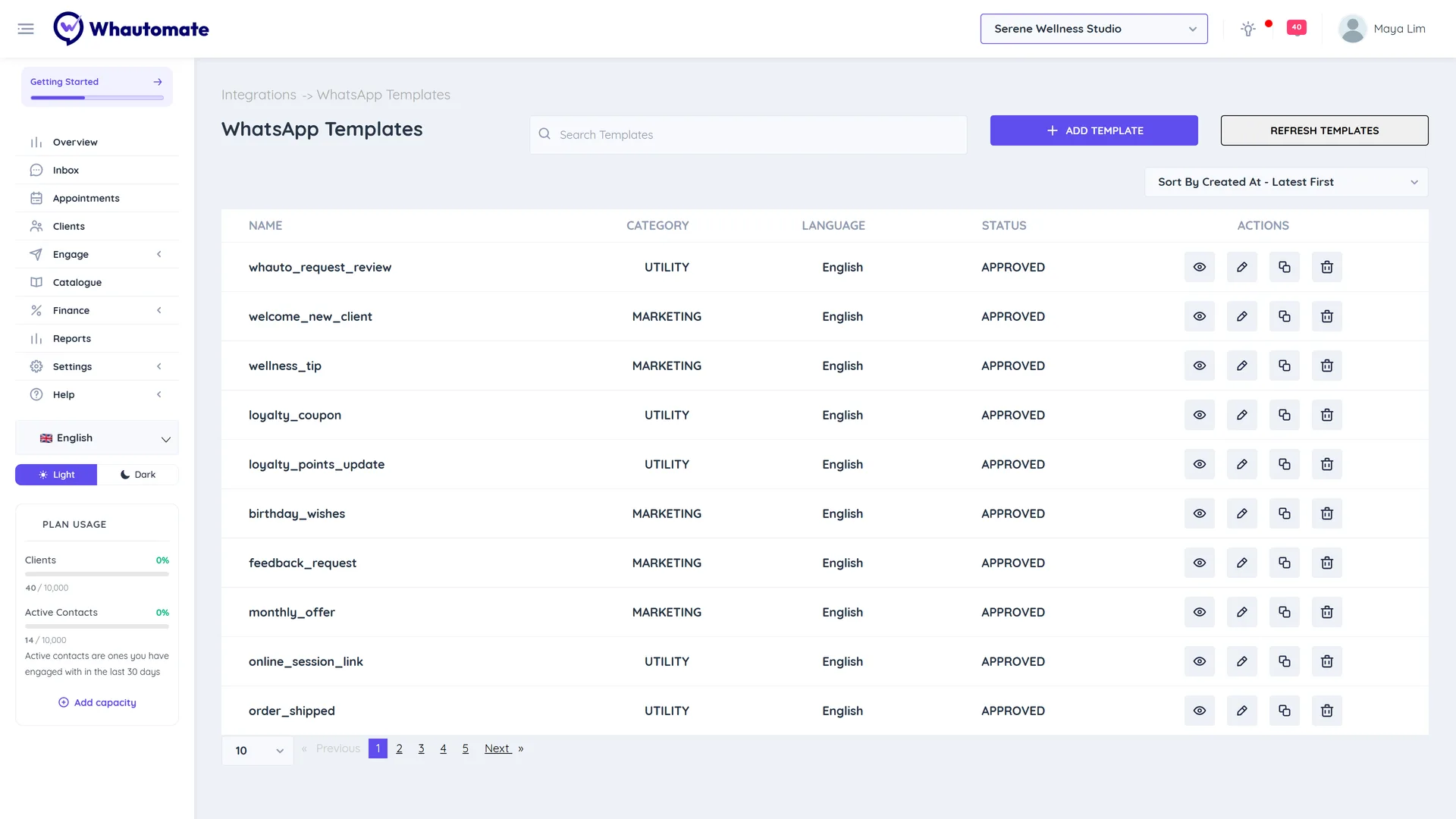
The list shows each template's Category, Language and Status. Use Search Templates and Sort By to find one. The actions on each row are Preview Template, Edit Template, Clone Template, Delete Template and, for archived templates, Unarchive Template.
Template categories
Meta sorts every template into a category, and charges and limits each category differently:
- Marketing: offers, announcements, newsletters, reminders to rebook and anything promotional. Under Type of Marketing Message you can choose Custom Message, Catalog Message (shows your WhatsApp catalog) or Carousel Message (2 to 10 scrolling cards, each with an image or video and up to 2 buttons).
- Utility: messages about something the customer already did or asked for, such as booking confirmations, appointment reminders, receipts and order updates.
- Authentication: one-time passcodes. The wording is fixed by Meta; you can add a security recommendation, an expiry time (1 to 90 minutes) and a Copy code button.
If Meta thinks a template belongs in a different category, it may change the category when it reviews the template.
Create a template
- Click Add Template.
- Choose how to start:
- Create your own: write the template yourself. It is reviewed by Meta after you save.
- Use a Meta template: browse Meta's pre-approved library. See Use a Meta template.
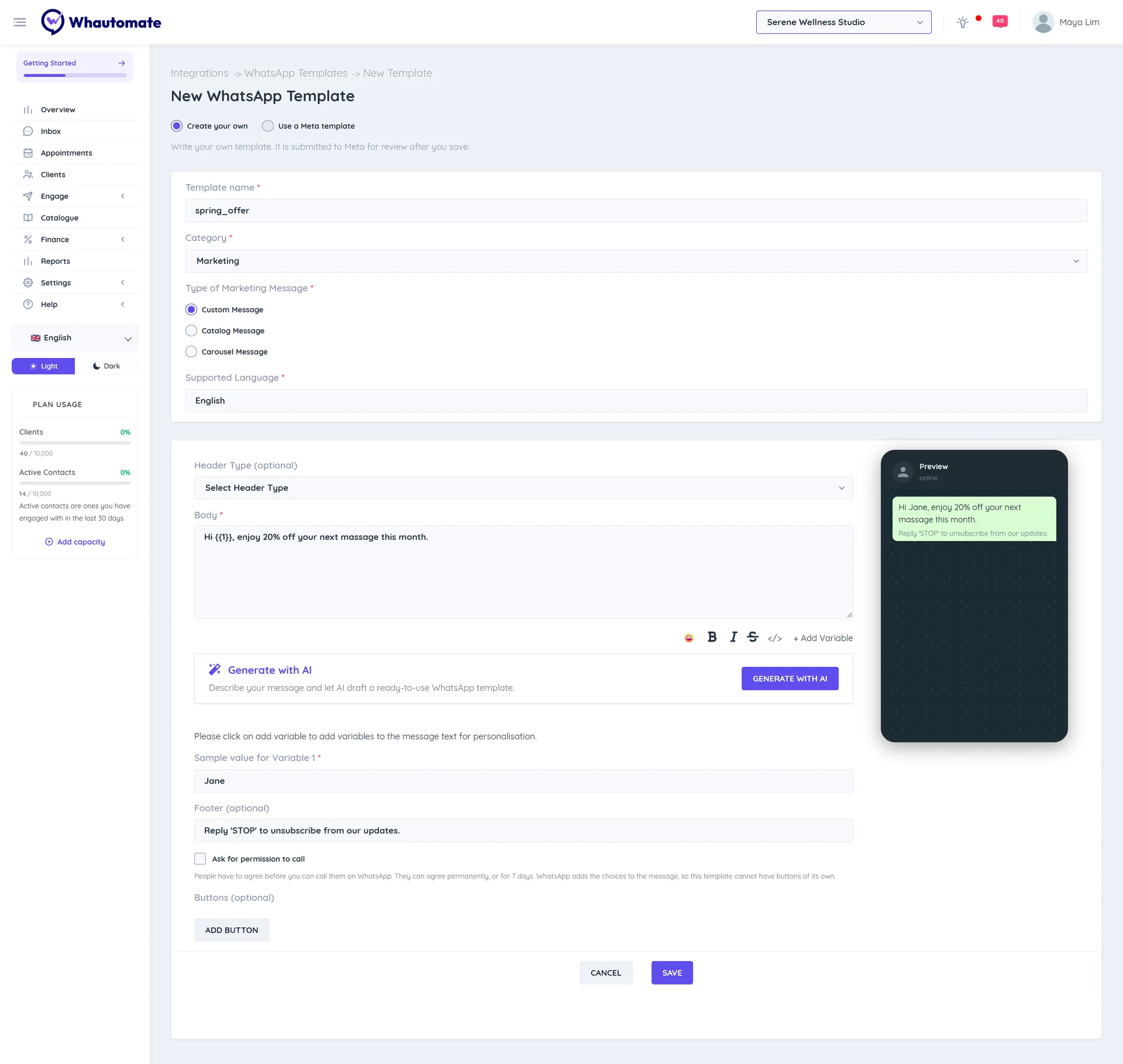
- Enter a Template name. Spaces are turned into underscores and the name is saved in lowercase, for example spring_offer.
- Choose the Category and the Supported Language.
- Optional: choose a Header Type (optional): Text, Image, Video, Document or Location. For media headers, upload a Sample Media file. Meta only uses it to review the template; you choose the real file each time you send.
- Write the Body (up to 1,024 characters). Click + Add Variable to insert a placeholder such as
{{1}}for details that change per person, then enter a Sample value for Variable so Meta can see an example. - Optional: add a Footer (optional) (up to 60 characters).
- Optional: add Buttons (optional) with Add Button: Visit Website (max 2 buttons), Phone Number (max 1 button), Quick Reply or Complete Flow (max 1 button) to open a WhatsApp Flow. A website button can be Static or Dynamic (with a variable at the end of the URL and an Add Sample URL).
- Optional, for numbers with WhatsApp calling: tick Ask for permission to call. WhatsApp adds Allow calls and Allow for 7 days choices to the message, so the template cannot have its own buttons.
- Check the Preview and click Save. You see Template saved successfully and submitted to Meta for review.
Write it with AI
On the form, click Generate with AI, describe the message under Describe your message (for example "Send appointment reminder with date, time and location"), choose the Template Category and click Generate. Check the Generated Template, then click Accept to fill in the form or Reject to try again. Each generation uses AI credits, shown as AI Credits in the window.
Use a Meta template
Choose Use a Meta template to browse the Meta template library. Filter by Language, Topic, Use case or Industry, or search by name or content, and click Use this template. The wording, category and language are fixed by Meta. Give it a Template name and set your own links and phone numbers under Button targets, then Save. Because the template is left unchanged, Meta approves it immediately: Template created from the Meta library and approved instantly - you can use it right away.
Approval and status
After you save, the template's Status shows PENDING while Meta reviews it. Review usually takes minutes and can take up to 24 hours. The status then changes to:
- APPROVED: ready to use in the Team Inbox, broadcasts, automations and reminders. Only approved templates can be picked when sending.
- REJECTED: Meta did not accept it. Common reasons are variables at the very start or end of the body, a sample value that looks like real customer data, or promotional wording in a Utility template. Edit the template and save it again, or create a new one.
- PAUSED or DISABLED: Meta paused or disabled the template because customers reported or blocked it. Improve the content or stop using it.
- ARCHIVED: Meta archives templates that have not been used for a long time. See below.
Status changes arrive automatically. To pull the latest list from Meta, including templates created in WhatsApp Manager, click Refresh Templates.
Unarchive a template
Meta archives templates that have not been used for a while and deletes them 28 days later. An archived template still holds its name and language, so you cannot create a new one with the same name. Click Unarchive Template on its row: you see Template unarchived, or Unarchive requested. The status updates once WhatsApp applies it. The template returns to the status it had before.
Edit, clone or delete
- Edit Template: change the template and save. It goes back to Meta for review: Template updated successfully and submitted to Meta for review. Meta limits how often an approved template can be edited.
- Clone Template: opens a new template with the same content, so you can make a variation or a version in another language.
- Delete Template: removes it from Meta as well. You cannot reuse the same name for a new template while Meta is deleting it.
Tips
- Keep templates short and specific, and use the category that matches the content.
- Add a way to opt out to marketing templates, such as a STOP quick reply. See Marketing opt-out management.
- Create a template in each language your customers use; each language is reviewed separately.