How to Use Personalisation Variables and Custom Fields
Personalisation makes your customer conversations more engaging by automatically inserting customer-specific details into your messages.
For example:
- Instead of sending “Hello there”, you can send “Hello {{Name}}” and Whautomate will replace
{{Name}}with your customer’s actual name.
1. What Are Personalisation Variables
Personalisation Variables are placeholders that Whautomate automatically replaces with actual data from your contacts, clients, or business settings in your Whautomate account.
Commonly used variables include:
- {{Name}} → Inserts the customer’s name
- {{Phone}} → Inserts the customer’s phone number
- {{Email}} → Inserts the customer’s email address
- {{Appointment}} → Inserts the scheduled appointment date/time, etc
- {{Business Name}} → Inserts your business name
How to Use Personalisation Variables in Messages
You can use Personalisation Variables and Custom Fields in:
- Automated Flows (appointment booking, surveys, feedback, etc.)
- Broadcasts (sending personalised promotions or updates at scale)
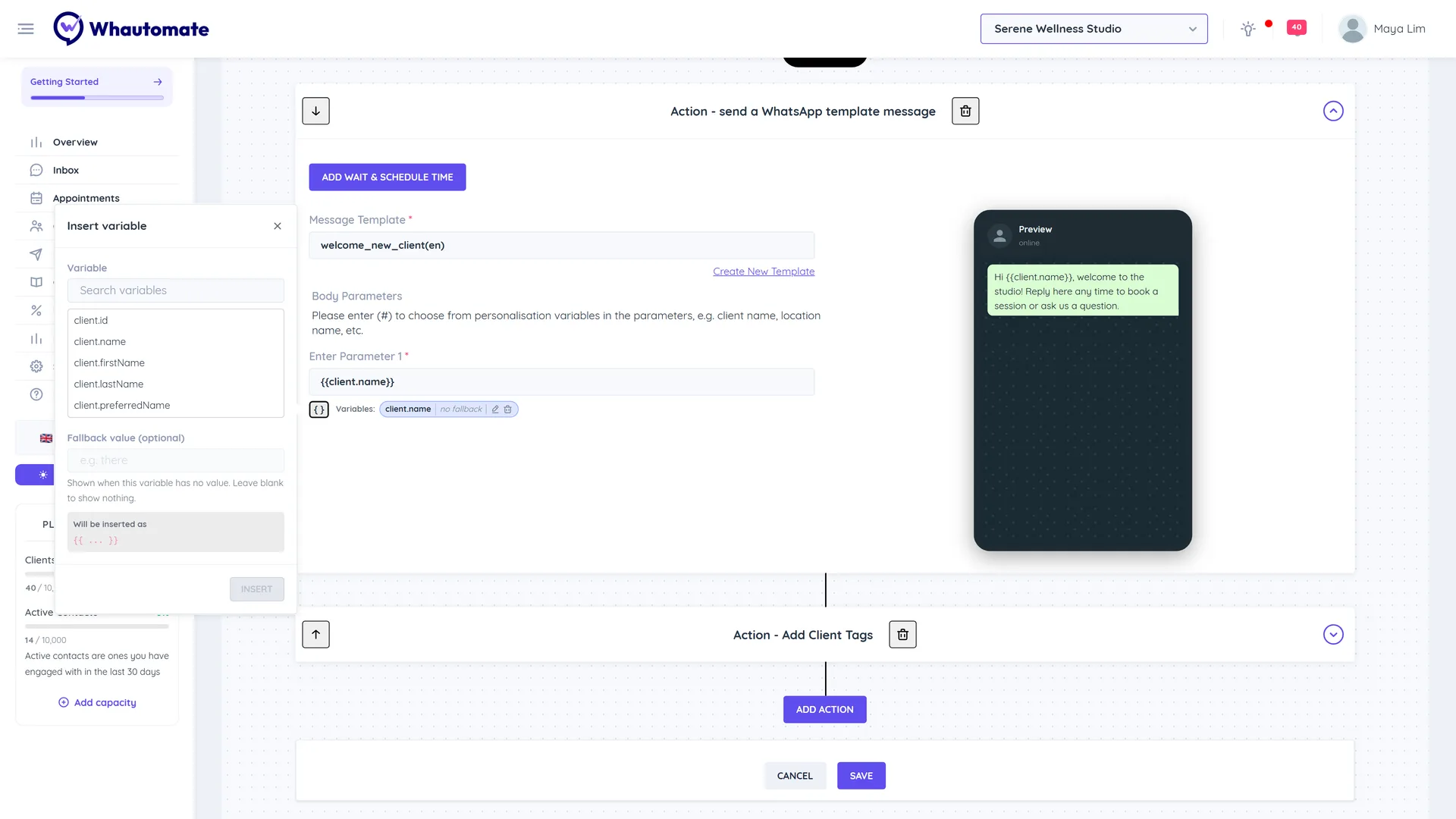
Tip: Type # in a message or parameter field and a list of variables pops up, or click the { } button under the field to open Insert variable. Pick a variable, optionally add a Fallback value for clients who have no value, and click Insert. For example, client.name inserts {{client.name}} and business.name inserts {{business.name}}.
Example:
Message Template:
“Dear {{appointment.clientName}}, Your appointment with {{appointment.practitioner}} at {{business.name}} on {{appointment.date}}, {{appointment.time}} is confirmed. Thank you for booking an appointment with us. Please let us know if you have any questions.
Have a great day!"
Customer Sees:
“Dear Nina Haas, Your appointment with Mr. John Doe at ABC Business on 25 Aug 2025, 09:00 AM is confirmed. Thank you for booking an appointment with us. Please let us know if you have any questions.
Have a great day!”
Available Personalisation Variables:
Client Variables
{{client.id}}, {{client.name}}, {{client.preferredName}}, {{client.age}}, {{client.gender}}, {{client.email}}, {{client.phone}}, {{client.calendarSyncURL}}, {{client.photoURL}}, {{client.address}}, {{client.emergencyRelationType}}, {{client.emergencyContactName}}, {{client.emergencyContactPhone}}, {{client.company}}, {{client.taxIdType}}{{client.taxIdNumber}}, {{client.availableFunds}}, {{client.customFields.fieldName}}
Contact Variables
{{contact.id}}, {{contact.name}}, {{contact.phone}}, {{contact.customFields.fieldName}}
Business Variables
{{business.name}}, {{business.address}}, {{business.phone}}, {{business.mapDirectionUrl}}, {{business.operatingHours}}, {{business.id}}
Appointment Variables
{{appointment.practitioner}}, {{appointment.date}}, {{appointment.time}}, {{appointment.previousDate}}, {{appointment.previousTime}}, {{appointment.clientName}}, {{appointment.addToCalendarURL}}, {{appointment.partialAddToCalendarURL}}, {{appointment.location}}, {{appointment.service}}, {{appointment.addons}}, {{appointment.detailsURL}}, {{appointment.partialdetailsURL}}, {{appointment.cancelURL}}, {{appointment.partialcancelURL}}, {{appointment.rescheduleURL}}, {{appointment.partialrescheduleURL}}, {{appointment.practitionerRole}}, {{appointment.price}}, {{appointment.timezone}}, {{appointment.businessTimezone}}, {{appointment.dateInBusinessTZ}}, {{appointment.timeInBusinessTZ}}, {{appointment.previousDateInBusinessTZ}}, {{appointment.previousTimeInBusinessTZ}}
Virtual/Online Session Variables
Guest Meeting URL: {{appointment.guestMeetingUrl}}
Meeting Password: {{appointment.meetingPassword}}
Host Meeting URL: {{appointment.hostMeetingUrl}}
Class Variables
{{class.clientName}}, {{class.date}}, {{class.time}}, {{class.practitioner}}, {{class.className}}, {{class.duration}}, {{class.onlineClassLink}}, {{class.onlinePassCode}}, {{class.addToCalendarURL}}, {{class.detailsURL}}, {{class.partialdetailsURL}}, {{class.cancelURL}}, {{class.partialcancelURL}}, {{class.addToCalendarEmailAttachmentURL}}, {{class.timezone}}
Bulk Class Variables
{{bulkClass.clientName}}, {{bulkClass.timezone}}, {{bulkClass.className}}, {{bulkClass.duration}}, {{bulkClass.practitioner}}, {{bulkClass.consolidatedSchedule}}, {{bulkClass.status}}
Form Variables
{{form.name}}, {{form.clientName}}, {{form.status}}, {{form.url}}, {{form.partialUrl}}, {{form.pdf}}, {{form.downloadId}}, {{form.id}}
Invoice Variables
{{invoice.number}}, {{invoice.totalAmount}}, {{invoice.pendingAmount}}, {{invoice.clientName}}, {{invoice.date}}, {{invoice.dueDate}}, {{invoice.pdf}}, {{invoice.notes}}, {{invoice.paymentUrl}}, {{invoice.partialPaymentUrl}}, {{invoice.paymentRequestId}}, {{invoice.downloadId}}, {{invoice.downloadUrl}}
Loyalty Program Variables
{{loyalty.pointsChanged}}, {{loyalty.availablePoints}}, {{loyalty.pointsChangedReason}}, {{loyalty.pointsToRedeemCoupon}}, {{loyalty.couponCode}}
2. How to Add & Manage Custom Fields in Clients and Contacts
Custom Fields let you save extra information about your clients and contacts beyond the standard details (like Renewal Date, Preferences, or Referred By). These fields can be used to personalise messages and create smarter automation.
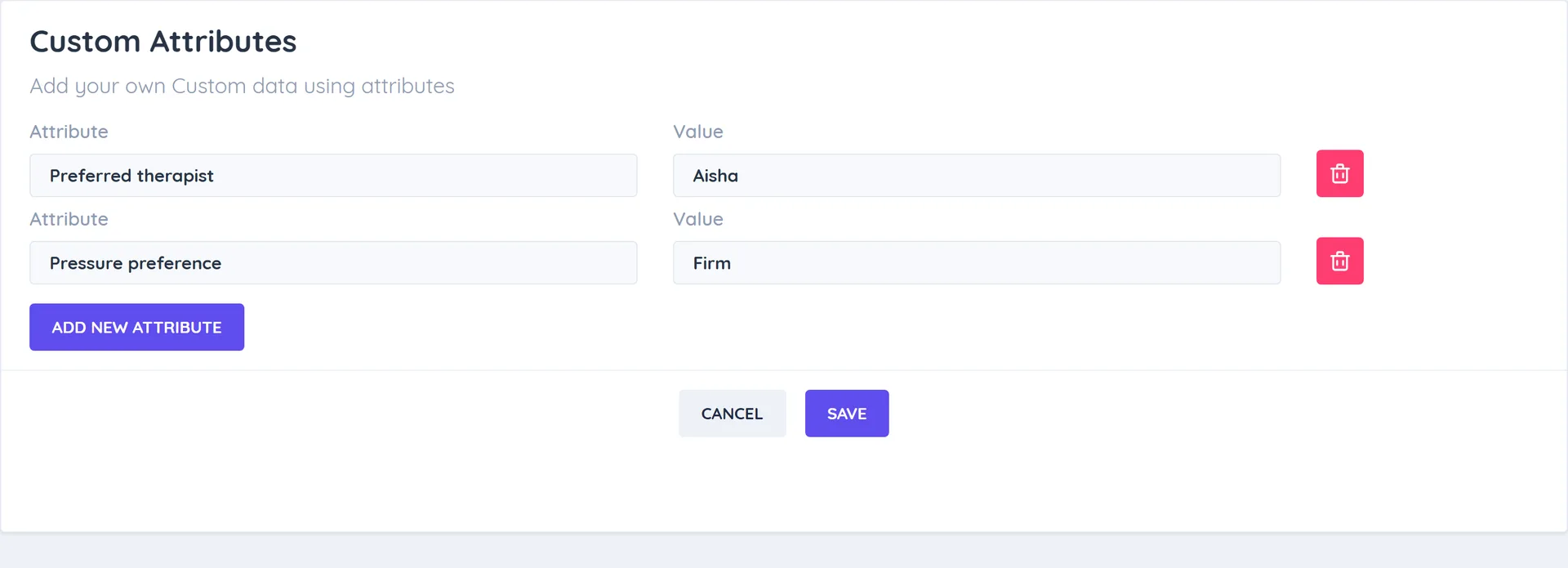
Adding Custom Fields to a Client
- Go to Clients and open the client you want to update.
- Click Custom Fields.
- Click Add New Attribute, then enter the Attribute (e.g., Subscription Date) and its Value (e.g., 25 August 2026).
- Click Save.
Adding Custom Fields to a Contact
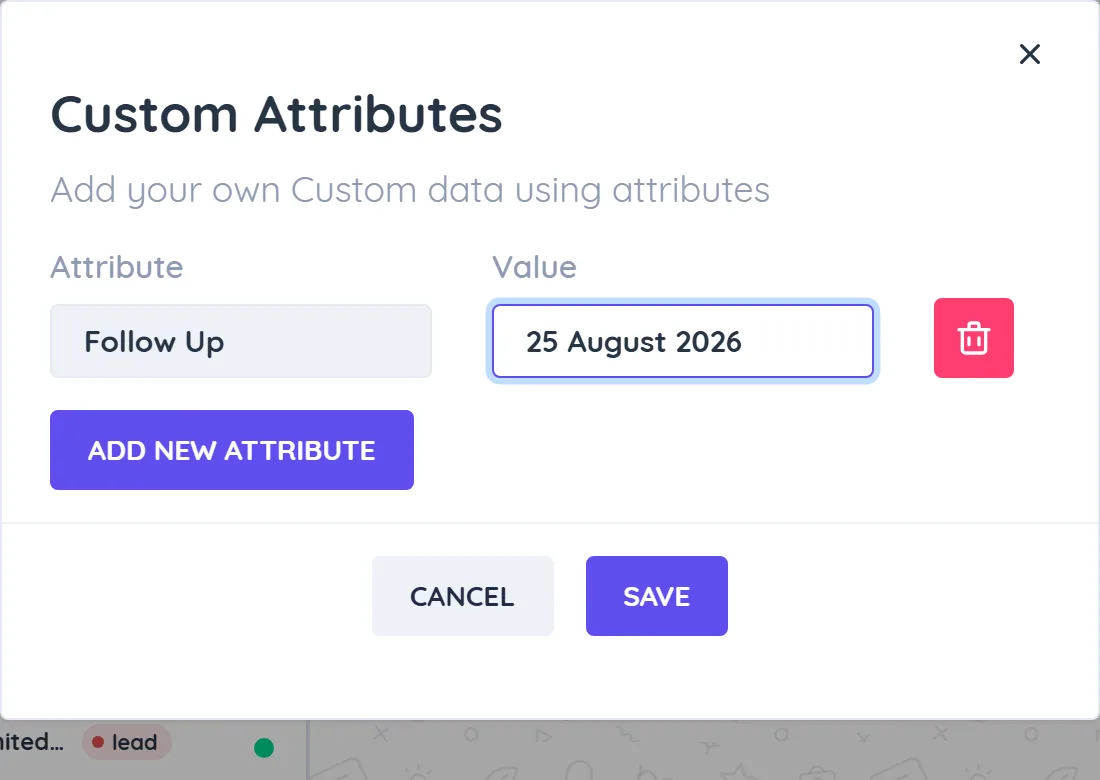
- Go to the Team Inbox.
- Select the contact you want to update.
- In the contact details panel, find Custom Attributes and click +.
- Click Add New Attribute, then enter the Attribute (e.g., Follow Up) and its Value (e.g., 25 August 2026).
- Click Save.
Using Custom Fields Variables in Messages
You can insert your Custom Fields into messages with variables.
1. Dot Notation (no spaces in field name)
Client: {{client.customFields.fieldName}}
Contact: {{contact.customFields.MembershipPlan}}
Example: “Hi {{client.name}}, your plan is {{contact.customFields.membershipPlan}}.”
Result: “Hi Sarah, your plan is Gold.”
2. Bracket Notation (for spaces/special characters)
Client:
{{client.customFields["subscription status"]}}
{{client.customFields['subscription status']}}

Contact:
{{contact.customFields["subscription status"]}}
{{contact.customFields['subscription status']}}
Example: “Hi {{client.name}}, status: {{contact.customFields['subscription status']}}.”
Result: “Hi John, status: Active.”
Tip: Use bracket notation if your field name has spaces.
Bulk Import with Custom Fields
When uploading clients or contacts via CSV file, you can include custom attributes directly.
Example CSV entries:
VIPStatus:"true" | PreferredBranch:"Branch1"
Example:
Field Name: VIPStatus and Value: True
Field Name: PreferredBranch and Value: Branch1
This way, every client/contact in the file will have the fields assigned automatically.
With Custom Fields, you can keep detailed client and contact records, making it easier to personalise messages to your audience.